New GridStack is now callable from Ergodex AI →

Physics that knows where it matters

Adaptive physical reasoning for chiplets and advanced packaging. Resolution on demand puts full fidelity where a design can fail and speed everywhere else, from fast analysis and design exploration to verified sign-off.

  • Electrical, thermal and mechanical, coupled
  • Verified numerical sign-off
  • Plugs into your existing flow
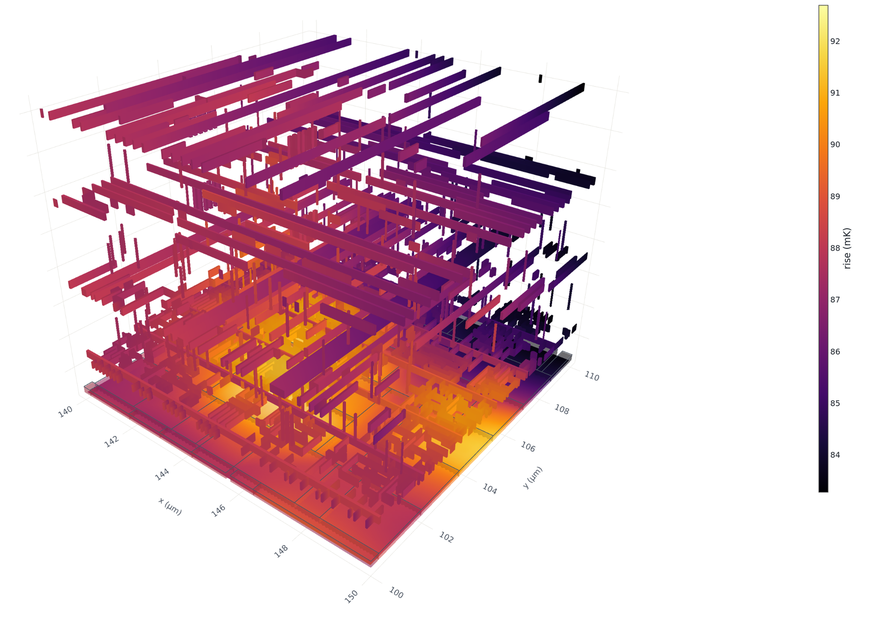
thermstack · layout · 50 nm
A 10 by 10 micrometre area of a processor core at 50 nanometres: the device layer and the signal wires of the first four metal layers, each coloured by its temperature rise
chip structure
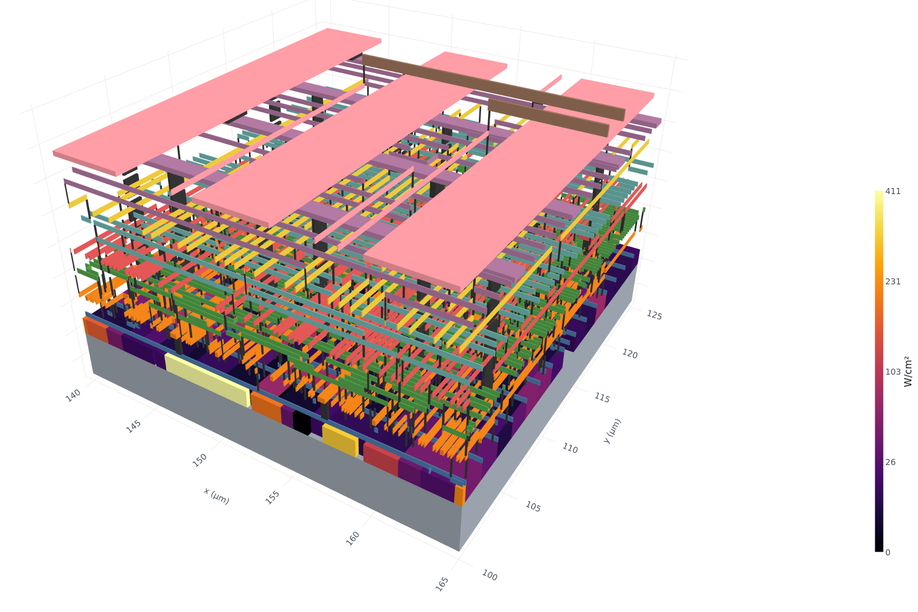
Chip structure of a 25 by 25 micrometre area: silicon, placed cells coloured by power density, and the wires and vias of all nine metal layers

Processor core at layout level: the modeled structure (inset) and the signal wires of M1–M4 over the device layer at 50 nm, each coloured by its own temperature rise. Actual modeled layout and thermal results; heights stretched.

Plugs into 3Dblox GDSII IPC-2581 · ODB++ OpenROAD Commercial EDA flows Ergodex AI Claude · Codex · open-weight LLMs
Adaptive physical reasoning

Not just always-on physics. Physics that knows where it matters.

Running physics everywhere, all the time, at one resolution still spends most of the compute on regions that cannot fail. Adaptive physical reasoning puts fidelity where the physics is hard, at the resolution you ask for, so one analysis is both high fidelity and computationally efficient.

Resolution on demand

Fine where it fails, coarse where it can't

The whole package stays in the model. Fine resolution goes where you need it: hot spots, die corners, the gaps between dies. Everything else stays coarse.
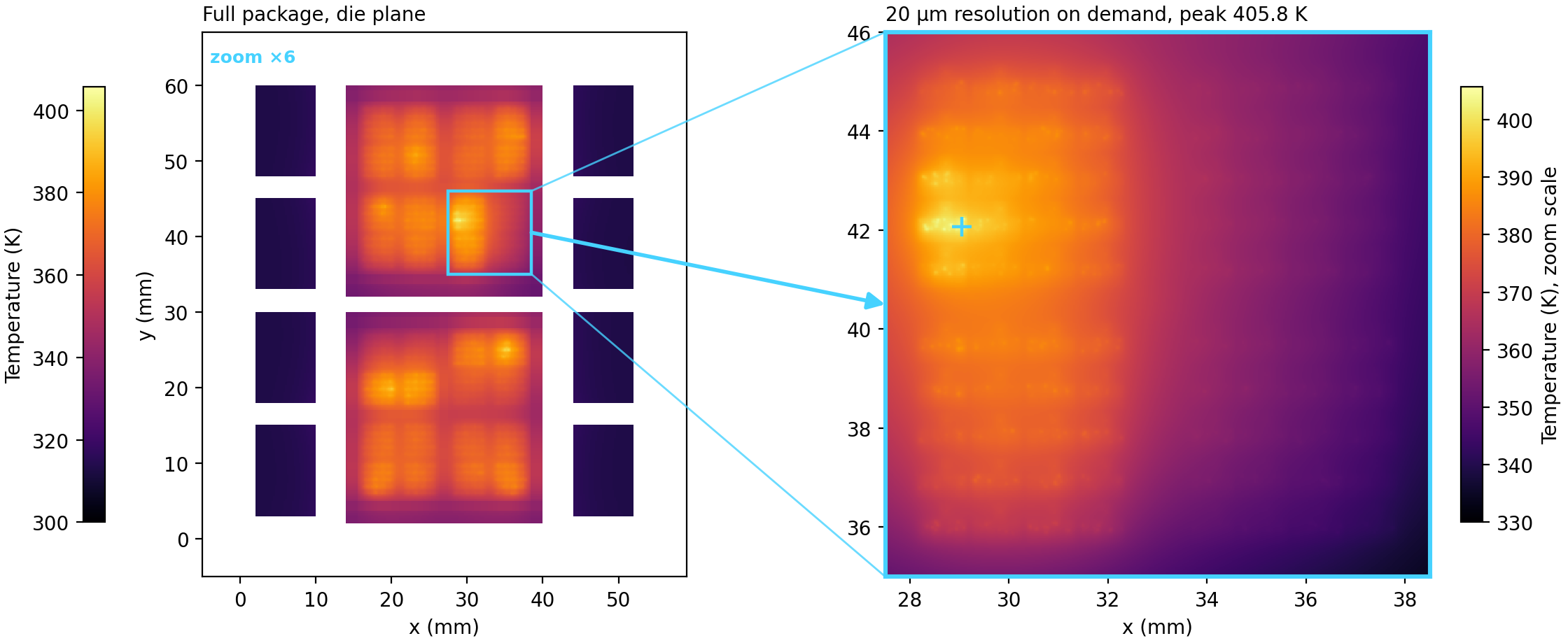
Full-package temperature map beside the hottest compute die resolved at 20 µm

Full package (left) and its hottest compute die at 20 µm (right, own colour scale). Modeled package, synthetic power maps.

Fidelity on demand

The right model for each question

AI surrogates explore, reduced-order solvers refine, and the full numerical reference signs off. Each question uses the cheapest model that is still right.

L3 Full-resolution numerical referenceground truth for sign-off sign-off
escalate when margins tighten
L2 Reduced-order & compact solversnarrow the space, resolve the finalists refine
escalate on promising candidates
L1 Learned surrogates (GNN)screen thousands of candidates explore

Fidelity and compute stop being a trade-off made once per project. They are decided on demand: per region, per candidate, per question.

Resolution on demand, measured

Terabyte-scale analysis, on one machine.

Uniform grids fine enough to see these features need terabytes of memory. Three new white papers show the same resolution on full accelerator packages, on a single machine. All white papers →

20 µmon all eight compute dies56 min and 106 GB on one CPU server, where a uniform grid is estimated at about 15 TB. ThermStack WP-104 →
10 µmat five critical corners5.4 min and 27 GB on one desktop, where a uniform mesh is projected at about 25 TB. Warpage within 0.2% of the converged reference. WarpStack No. 04 →
974 Wchip, package and board in one modelHottest compute die at 50 µm in 1 h 20 min and 110 GB, straight from the design files. ThermStack WP-105 →

Modeled accelerator packages with synthetic layouts or power maps, not vendor data. Uniform-grid figures are estimates and projections, not solved runs. Results will differ on other hardware.

Why NoveetyAI

Built for how chiplets actually fail.

Advanced packages fail where physics couples, and margins are only as good as the reference behind them.

01 · Coupled physics

Electrical, thermal and mechanical, coupled

IR-drop heats the die, heat ages the wires, mismatch bends the package. Thermal, warpage, electromigration and power-integrity engines work together, so real temperature maps drive reliability instead of a uniform-die guess.

02 · Verified sign-off

Every fast answer, checked

Each engine carries its own full numerical reference. Fast answers are confirmed against it in the same tool, and the accuracy is published in our white papers and benchmarks.

03 · Your flow

Plugs into what you run

Start from the files your teams already have: 3Dblox, GDSII, IPC-2581 and ODB++ in, structured results out. Works with OpenROAD, commercial EDA flows and agentic platforms such as Ergodex AI.

The engines

Four engines enforce and gate the physics — AI accelerates them

Every engine pairs fast AI and reduced-order models with a full numerical reference, and every analysis is a CLI call an agent can make. Our main focus today is thermal and warpage: ThermStack and WarpStack.

Thermal analysis

ThermStack

Temperature fields from chip, package and board design files, with hot spots resolved on demand, from 20 µm on a package to 50 nm on a die.

Resolution on demandChip + package + boardThermStack-GNN
Thermal-mechanical stress

WarpStack

Package warpage and corner stress in one run, from fast design sweeps to sign-off.

Resolution on demandWarpStack-GNNWarpStack-MOR
Electromigration

MetalStack

Electromigration, thermomigration and IR-drop solved together, with lifetime prediction.

Coupled EM / TM / IRReal thermal mapsLifetime prediction
Power integrity

GridStack

Transient power-grid simulation and dynamic IR-drop on full-chip grids.

Dynamic IR-dropFull-chip gridsErgodex AI integration
Agentic flow

An engineered loop, not a prompted one.

Set the objectives once. Agents propose candidates, our engines evaluate each at the resolution it needs, and a separate verifier signs off on the numerical reference.

Engineered agentic loop: design, evaluate, verify, sign off A human sets objectives, budget and stopping conditions once. A loop controller driven by an LLM — Claude, Codex or an open-weight model — then runs unattended: it proposes design candidates in parallel, drives traditional EDA tools and the NoveetyAI physics engines to evaluate them, and hands the resulting margins to a separate verifying agent that checks them against the stopping condition on the numerical ground-truth engine. If the condition is not met, results and run history feed back through persistent memory into the next iteration; if it is met, the design proceeds to sign-off. OBJECTIVES · SET ONCE, BY A HUMAN targets · budget · stopping conditions MEMORY run history Pareto front what has been tried persists across runs LOOP CONTROLLER · RUNS UNATTENDED Claude / Codex / Open-Weight LLM proposes candidates · spawns parallel workers · reads margins no per-step prompting — the loop writes its own next move ① DESIGN — N CANDIDATES IN PARALLEL TRADITIONAL EDA Major commercial EDA flow OpenROAD synthesis · place & route · extraction · STA emits netlist, P/G grid, power maps NOVEETYAI ENGINES ThermStack — thermal WarpStack — warpage MetalStack — EM · TM · IR GridStack — transient IR-drop resolution on demand · CLI · JSON grid · power · geometry ② EVALUATE margins MARGINS worst-case droop · time-to-failure · hotspot temperature · peak-to-peak bow ③ VERIFY — MAKER ≠ CHECKER a separate agent tests the margins against the stopping condition — on the numerical ground-truth engine met ④ SIGN-OFF integrity + reliability OPTIMIZE — NOT MET, ITERATE
Start with your package

Put integrity back in the loop.

See it on your own 2.5D/3D chiplet design, or read the technical white papers first.