AI-native EDA · Agentic flows · Chiplets & advanced packaging

Agentic flow for chip integrity and reliability validation, optimization and sign-off

Physics has become a first-order design constraint for VLSI chips — including chiplet and system-in-package designs — where electrical, thermal and mechanical behavior no longer separate. NoveetyAI makes that coupled physics fast enough to compute on every candidate: integrity across power delivery, thermal and electromagnetics; reliability across electromigration and thermal-mechanical stress. We pair LLM reasoning with an agentic engineering flow for multiphysics-aware design and optimization — validation and sign-off today, automatic design and optimization next.

We are an AI-native EDA company, not a classical one retrofitting AI. We develop learned physics — PINN, GNN and transformer solvers — alongside the numerical ground truth that makes them trustworthy, and an agentic flow built to drive both.

ThermStack-AI · 0.59 ms PINN + transformer WarpStack-AI · ~1.5 ms AI warpage inference MetalStack-AI · 86× within 0.05% of reference GridStack · 11.9× faster transient IR-drop
4
Hybrid multiphysics engines
3
Engines with AI solvers
120,000×
Peak AI speedup (warpage)
100%
CLI-first, agent-callable
The shift

Physics is now a first-order design constraint

The industry has converged on this. Writing for Semiconductor Digest, Synopsys' Larry Williams argues that stacked architectures, chiplets and 3DIC packaging have made electrical, thermal and mechanical behavior impossible to separate — effects once treated as second-order now govern performance, yield and reliability, and physics has to enter at design time rather than wait for downstream sign-off.

"The physics is coupled."

That is the premise NoveetyAI is built on: in an advanced package, a flow that analyzes each domain in isolation is describing a chip that doesn't exist.

Larry Williams · Synopsys "Silicon Meets Reality: Why Physics Is Now a First-Order Design Constraint for Chips" — Semiconductor Digest ↗

And the cost of getting it wrong is not theoretical. Industry analysis attributed NVIDIA's Blackwell delay to a thermal-mechanical failure in TSMC's CoWoS-L package: coefficient-of-thermal-expansion mismatch between the GPU chiplets, LSI bridges, RDL interposer and substrate. The reported remedy was a redesign of the top metal layers and bump structures, plus requalification before mass production could resume.

"…causes warpage and failure of the whole SiP."

Warpage is not a late cosmetic check. On the most closely watched silicon in the industry, it moved a schedule — and it is precisely the physics WarpStack computes.

Phil Garrou · Packaging IFTLE 607 "Why Nvidia's Blackwell is Having Issues with TSMC CoWoS-L Technology" — 3D InCites, October 2024 ↗

Recognizing the problem is not the same as solving it. Moving physics to design time only works if the physics is fast enough to be called on every candidate — and if something is driving those calls. Sign-off simulators are accurate but far too slow to sit in an optimization loop, so integrity still gets checked last, when it is most expensive to fix. NoveetyAI closes both halves: multiphysics engines built for loop speed, and an agentic flow that acts on what they return.

🕸️

Sign-off doesn't scale

Direct transient solves on million-node grids and full 3D FEM thermal runs cost minutes each. A design-space search needs thousands of evaluations.

🔗

The physics is coupled

IR-drop drives Joule heating; heat drives electromigration and thermomigration; CTE mismatch drives stress and warpage. Analyzed in isolation, each one lies.

🤖

Agents need callable physics

An autonomous design agent can only optimize what it can invoke. GUI-bound, hand-run analysis cannot close the loop.

Coupled effects → callable engines

Each coupling the industry now calls first-order maps onto an engine fast enough for an agent to invoke thousands of times.

Thermal–mechanical — CTE mismatch concentrates stress on microbumps, solder joints and TSVs across the stack
WarpStack Warpage and peak-to-peak bow, 2D screening to 3D sign-off
Electrical–thermal — power density raises temperature, which raises resistance and IR-drop, shifts mobility and leakage
GridStack + ThermStack Transient IR-drop coupled to full temperature fields
Thermal-driven reliability — Joule self-heating accelerates electromigration and thermomigration in the power grid
MetalStack EM + TM + IR solved together, with Monte Carlo lifetime
Power delivery noise — simultaneous switching couples into timing across die, package and board
GridStack Full transient power-grid simulation on million-node designs
The product suite

Four engines. Numerical and AI in the same tool.

Every tool ships with a first-class CLI and a structured data interface, so each analysis becomes a callable step inside your agentic EDA flow — the evaluation core that our agentic design and optimization build on. Three of the four now run a developed AI engine alongside their physics-exact solver.

Thermal analysis

ThermStack

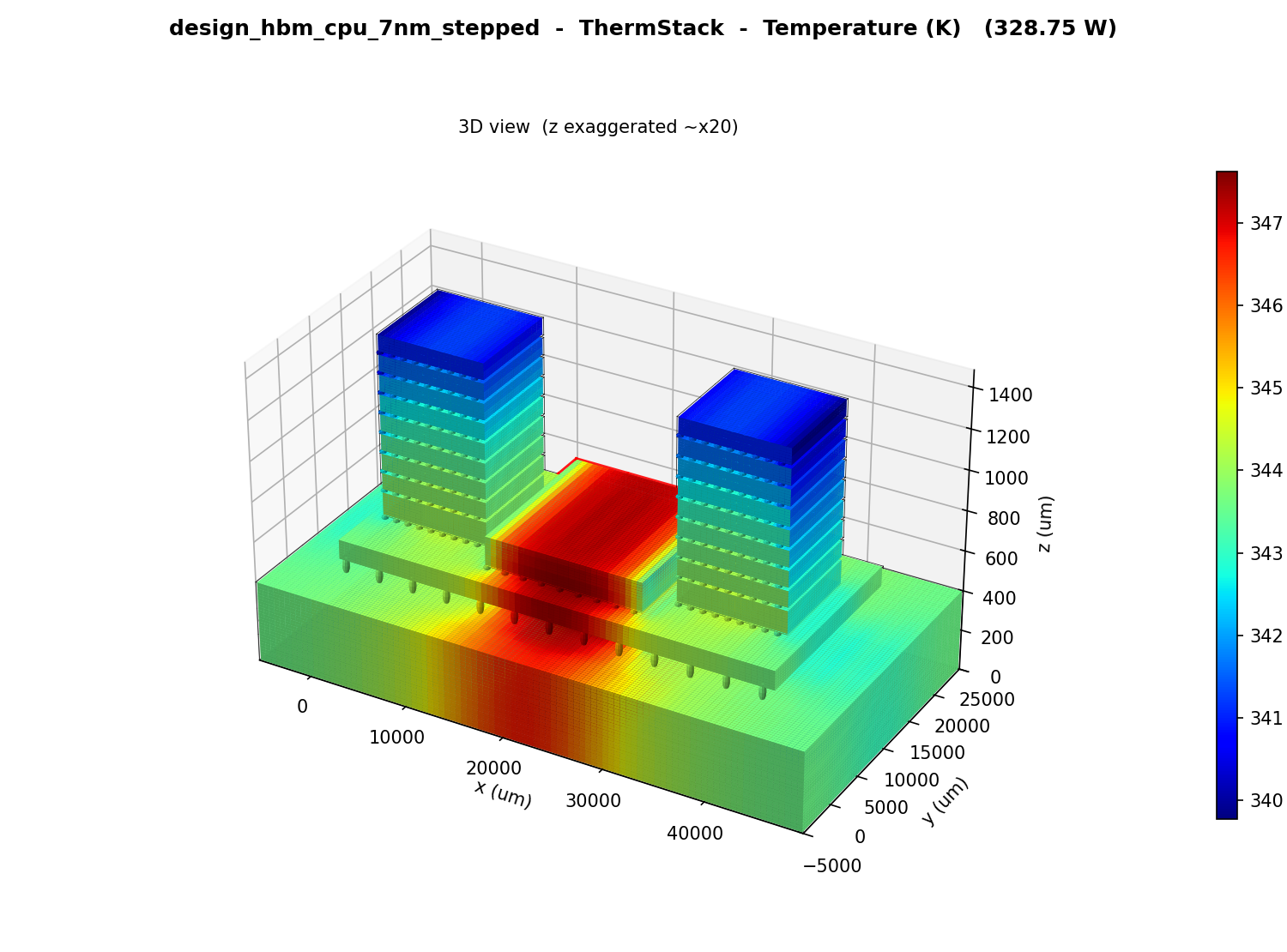
FEM-grade static and transient thermal analysis for 2.5D and 3D chiplet stacks. A spectral solver returns full temperature fields in ~0.02 s — fast enough for real-time thermal management.

1400×vs. 3D FEM
0.59 msThermStack-AI
Thermal-mechanical stress

WarpStack

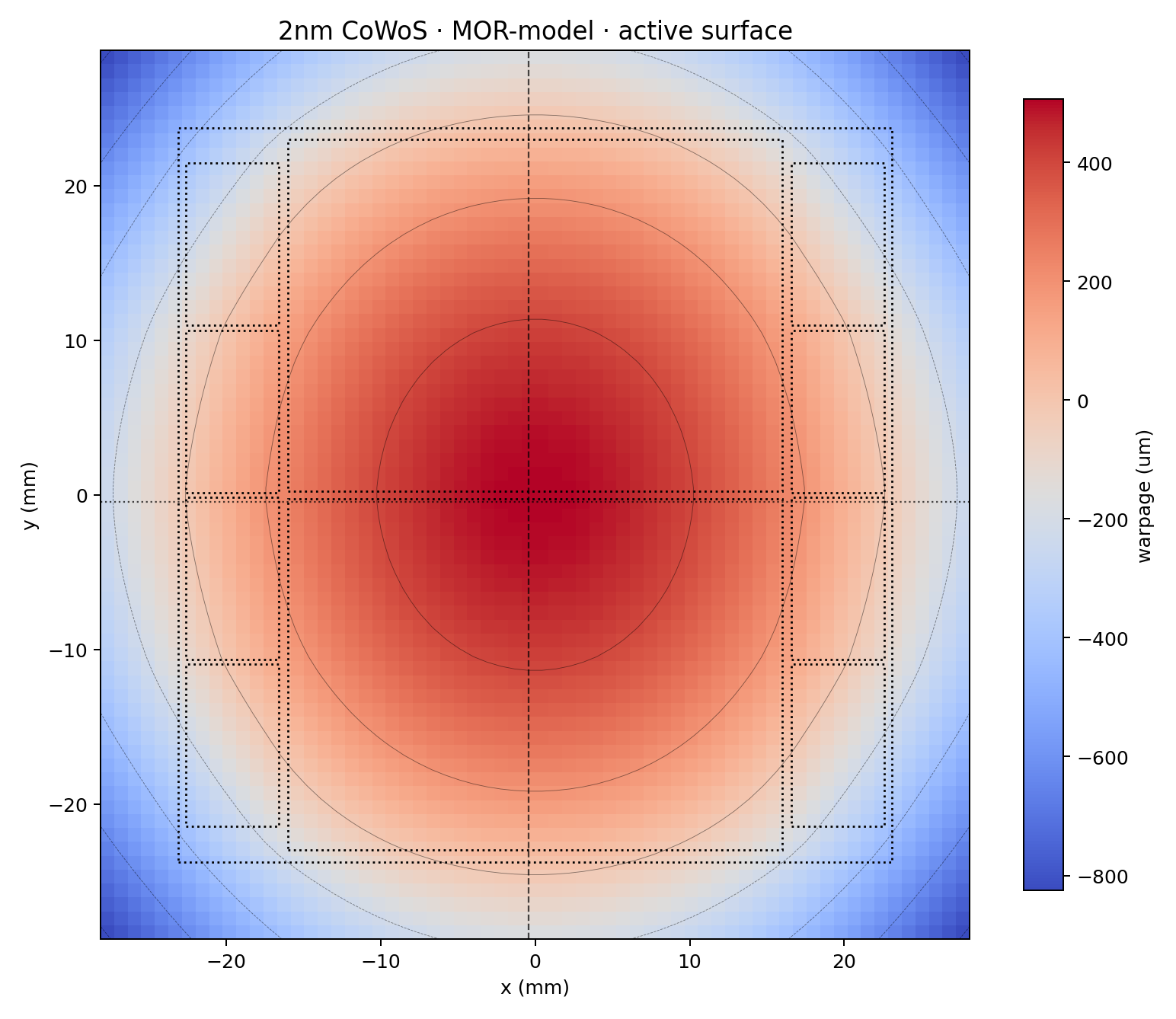
Thermal warpage analysis for 2.5D and 3D packages. Fast 2D screening in ~0.35 s per design plus detailed 3D sign-off up to 11 layers — warpage maps and peak-to-peak bow, before the package ships.

0.35 s2D solve, any design
~1.5 msWarpStack-AI (AI)
Electromigration

MetalStack

Full-chip, temperature-aware multiphysics: coupled electromigration, thermomigration and IR-drop over real power grids — with spatial thermal maps, Joule self-heating, resistance feedback, and Monte Carlo lifetime prediction.

EM+TM+IRcoupled solve
86×MetalStack-AI (AI)
Power integrity

GridStack

Rapid full-chip power integrity analysis and visualization. Full transient power-grid simulation and dynamic IR-drop on million-node designs — via advanced Krylov subspace reduction, at essentially exact accuracy.

11.9×vs. direct solve
<6e-6max norm. error
What makes us different

AI-native engines, built alongside the physics

Incumbent EDA vendors are bolting AI onto numerical cores architected decades ago. We build the other way round: in a NoveetyAI tool the AI engine and the physics-exact engine are the same product — same inputs, same CLI, same output schema. You explore at millisecond speed and confirm against ground truth without ever leaving the tool. Three of our four tools now have an AI engine developed alongside their numerical solver.

Physics-informed + transformer

ThermStack-AI

Two neural solvers beside two numerical ones. The PINN handles parametric design-space sweeps and uncertainty quantification; the transformer returns live thermal maps straight from on-chip telemetry.

AI inference0.59 ms
Mean error0.23 K
Solver engines2 num + 2 AI
Graph neural surrogate

WarpStack-AI

Warpage maps at numerical-grade fidelity in milliseconds — a graph network that follows the package's own layer and interconnect topology, so warpage finally runs at the speed of the optimization loop.

AI inference~1.5 ms
vs. 3D numerical120,000×
Error vs ground truth~1%
Physics-informed neural

MetalStack-AI

Full-chip electromigration and reliability, AI-accelerated — and every answer arrives with its own confidence range attached, with no separate statistical run to set up.

vs. numerical engineup to 86×
vs. commercial toolsup to 243×
Of referencewithin 0.05%

AI you can sign off on — not AI you can only explore with

The reason surrogate models have never reached sign-off is trust: a fast answer with no way to check it is a guess. Every NoveetyAI AI engine is built and continuously measured against its own numerical reference solver in the same tool — so each fast answer carries a known error bound against ground truth, and confirming it is one flag, not a different vendor's product.

That is what "AI-native" has to mean in EDA. Not a chatbot bolted to a GUI, and not a surrogate you cannot audit: learned physics with a numerical ground truth beside it, callable by an agent thousands of times an hour. GridStack remains purely numerical today — advanced Krylov reduction at essentially exact accuracy — and its AI mode is in development.

How it fits together

An engineered loop, not a prompted one

The discipline that makes agents useful in production has moved up a level — from harness engineering, which makes one agent run reliable, to loop engineering: designing the system that prompts the agent so a person doesn't have to. A human sets the objectives, the budget and the stopping condition once. After that the loop runs unattended — proposing candidates in parallel, evaluating each against real physics, verifying with a separate agent, and feeding its own history back into the next iteration.

That is the shape an EDA flow has to take before physics can sit inside the optimization rather than after it. Evaluation and sign-off ship today; agentic design and optimization are emerging.

Engineered agentic loop: design, evaluate, verify, sign off A human sets objectives, budget and stopping conditions once. A loop controller driven by an LLM — Claude, Codex or an open-weight model — then runs unattended: it proposes design candidates in parallel, drives traditional EDA tools and the NoveetyAI physics engines to evaluate them, and hands the resulting margins to a separate verifying agent that checks them against the stopping condition on the numerical ground-truth engine. If the condition is not met, results and run history feed back through persistent memory into the next iteration; if it is met, the design proceeds to sign-off. OBJECTIVES · SET ONCE, BY A HUMAN targets · budget · stopping conditions MEMORY run history Pareto front what has been tried persists across runs LOOP CONTROLLER · RUNS UNATTENDED Claude / Codex / Open-Weight LLM proposes candidates · spawns parallel workers · reads margins no per-step prompting — the loop writes its own next move ① DESIGN — N CANDIDATES IN PARALLEL TRADITIONAL EDA Major commercial EDA flow OpenROAD synthesis · place & route · extraction · STA emits netlist, P/G grid, power maps NOVEETYAI ENGINES ThermStack — thermal WarpStack — warpage MetalStack — EM · TM · IR GridStack — transient IR-drop numerical + AI · CLI-first · structured JSON grid · power · geometry ② EVALUATE margins MARGINS worst-case droop · time-to-failure · hotspot temperature · peak-to-peak bow ③ VERIFY — MAKER ≠ CHECKER a separate agent tests the margins against the stopping condition — on the numerical ground-truth engine met ④ SIGN-OFF integrity + reliability OPTIMIZE — NOT MET, ITERATE

CLI-first

Every analysis is scriptable. Nothing in the loop needs a GUI.

Structured I/O

Machine-readable inputs; fields, margins and hotspots out.

Flow-agnostic

Plugs into any agentic orchestration layer you already run.

Closed-loop

Optimize against real physics, not a surrogate proxy.

Services

Agentic design tools for integrity and reliability on your flow

Beyond the tools, we run the flow for you. Our team couples the NoveetyAI simulation engines with commercial and open-source implementation flows — a major commercial EDA design flow and OpenROAD — to deliver agent-driven RTL-to-GDSII and package co-design with integrity closed in the loop.

Major commercial EDA flow

Agent-driven synthesis, place & route, and sign-off on the industry-standard flow.

OpenROAD

Open-source RTL-to-GDSII, fully scriptable and ideal for autonomous exploration.

Package co-design

Thermal, warpage and power integrity co-optimized across the chiplet stack.

Digital twins

Thermal and reliability twins for advanced packages and chiplet systems.

Where we're going

From integrity evaluation to integrity-aware design

Our hybrid numerical + AI engines already make integrity and reliability observable at loop speed. Next, the agent acts on what it sees: proposing and optimizing designs that are integrity- and reliability-aware by construction. The destination is a single closed loop where the agent designs, optimizes, and eventually signs off.

Available now
Phase 01 · Evaluate

Hybrid numerical + AI evaluation

Four physics engines — three with an AI solver developed beside the numerical one — returning machine-readable margins over real power grids and 2.5D/3D stacks, callable thousands of times inside your agentic flow.

  • Transient IR-drop, EM/TM lifetime, thermal fields, warpage
  • AI solvers developed, each with a numerical ground truth
  • CLI-first, structured JSON out — accurate enough for sign-off
In development
Phase 02 · Design & optimize

Integrity- & reliability-aware design

The agent stops merely scoring candidates and starts proposing them — floorplan, power delivery, decap, chiplet partition and stack-up optimized against real physics, not a surrogate proxy.

  • Physics-in-the-loop optimization
  • Reliability budgeted by construction
  • Products releasing in stages
Roadmap
Phase 03 · Close the loop

Autonomous design-to-sign-off

Design, optimization and sign-off in one agentic loop — carrying a chiplet system from intent to a verified, integrity- and reliability-clean hand-off.

  • Intent-to-sign-off automation
  • Full integrity + reliability closure
  • Human oversight at the gates

Physics is the gate

No matter how fast the flow becomes, or how much of it an agent drives, hardware is ultimately limited and gated by fundamental physics. Signal integrity, power and thermal integrity, electromigration and thermal-mechanical aging are not soft objectives an optimizer can trade away — they decide whether a part works at all, and whether it still works years later in the field.

That is the role NoveetyAI's sign-off capability plays in an agentic EDA flow. An agent may explore thousands of candidates with fast surrogates, but every candidate it advances is checked against physics-grade engines validated on a ground-truth reference solver. Speed moves the search; physics decides what ships.

Put integrity back in the loop.

The NoveetyAI suite is in active development. Request access or a walkthrough on your own 2.5D/3D chiplet designs, and we'll get you set up.